
Japan is somehow both hyper-efficient and completely inefficient at the same time.
Everyone’s heard about how Japan still uses fax machines, and yes, that’s true. I learned how to use one when I came here, how else was I supposed to know what to do at the elementary schools? Plus, we’re also still (sort of) required to use bank passbooks, something we ditched in New Zealand when I was a kid. Not to mention ATMs have opening hours (true story, makes you wonder what the ‘A’ even stands for).
But there’s one thing Japan does that really beggars belief.
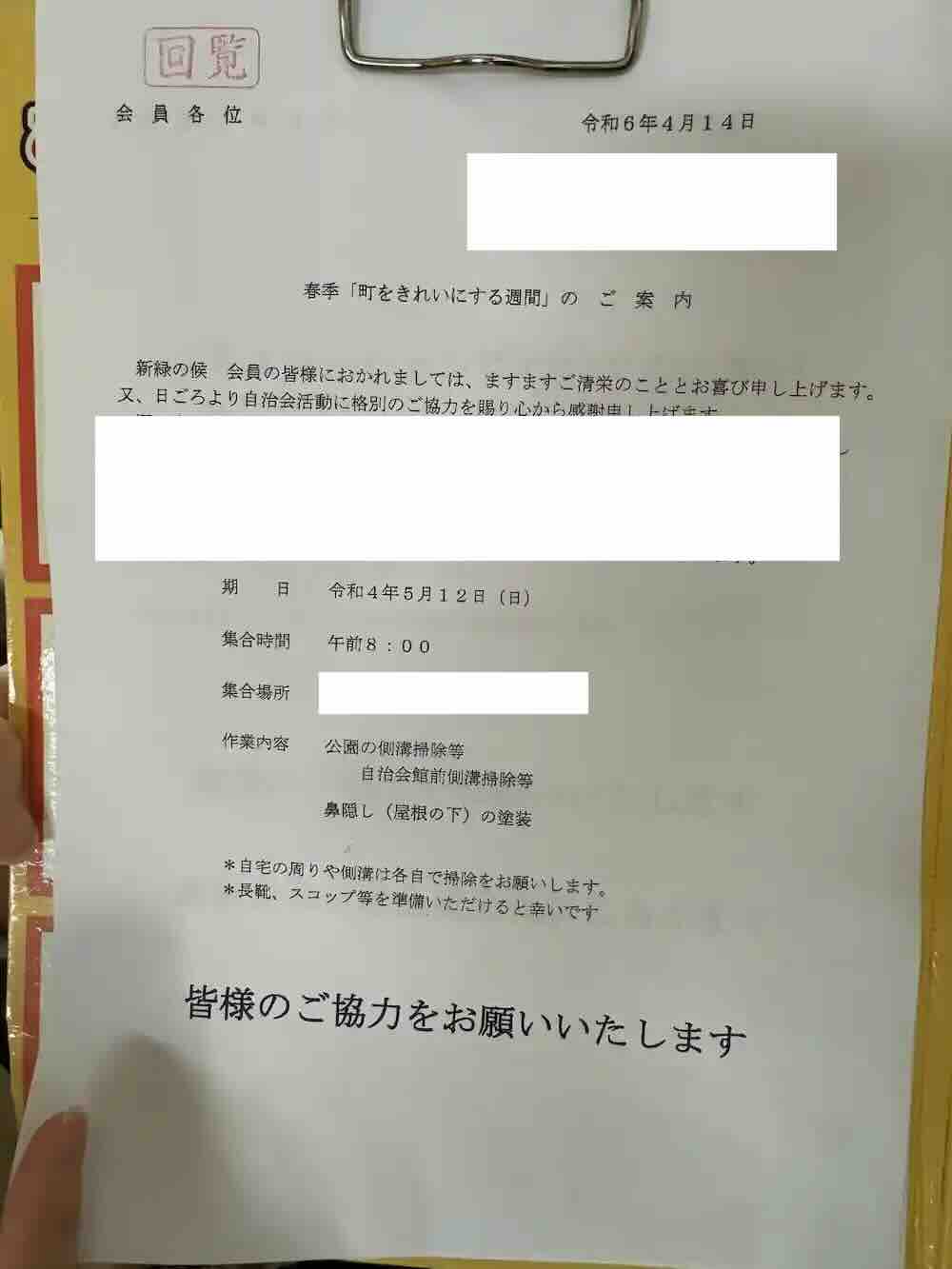
It’s called Kairanban,
essentially a clipboard of local notices that gets passed from house to house around the neighbourhood.
If someone’s away, you’re supposed to let your neighbour know to skip you. Either way, the fact we’re still using what is essentially a manual mail system in 2025 is just… unfathomable. More often than not, by the time it gets to our house, the events have already finished.
Now, don’t get me wrong. I love hearing about the little things going on around town, like old Mrs. Sato holding a mountain vegetable foraging event, or Mrs. Tanaka’s cooking lessons. I just wish I heard about them before they happened.
My mother-in-law was shocked to hear that we don’t have an equivalent to Kairanban in New Zealand. Well, not that I know of. Unless, of course,
you mean email?
Either way, one thing you notice when you spend time in Japan is that houses in the countryside are always clustered. They’re grouped in little hamlets with other houses nearby. The only things you see standing alone are shrines, which explains the random patches of forest in the middle of rice fields, and maybe rice silos (fittingly called “country elevators”), or the odd graveyard.
Some of you might be thinking, “isn’t it normal for houses to be close together?”
At least, not in New Zealand.
In rural NZ, houses are often completely separate. People living on farms tend to be far from their neighbours. I’m not entirely sure why, maybe it reflects a difference in mindset. A more individualistic “I can look after myself, thanks” kind of attitude.
Which is great and all, but honestly, I still think I prefer the Japanese way.
For starters, it has to be more efficient. Unless you’re totally self-sufficient (which is more doable these days), you’d need a ridiculous amount of piping, wiring, and whatever else just to connect all those standalone homes to the grid. In Japan, it’s simpler, you just link each hamlet up as a unit.
I also think the psychological side of it is better too. Sure, there’s the gossip, like Mr. Ito’s chronic athlete’s foot (gross). Sure, there’s peer pressure, like always labelling your rubbish bags (well, you’re supposed to at least). But overall, having a built-in community right at your doorstep has to be a huge plus, especially in a world where record numbers of people are living alone.
It helps to have some kind of gentle check-in system with your neighbours. And if that system happens to be a clipboard, well… so be it.