
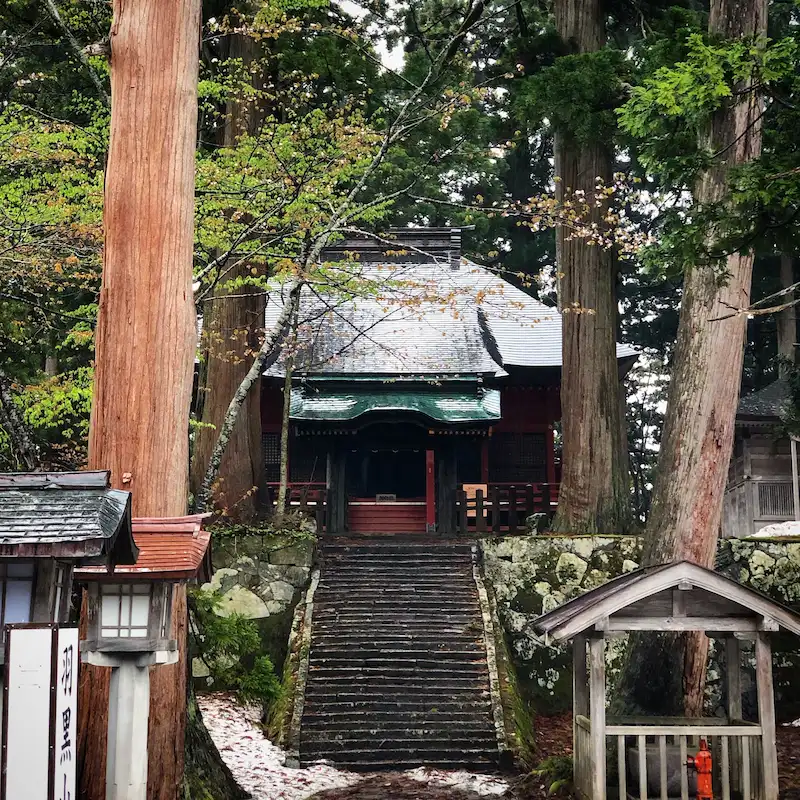
The stone stairway amongst the cedar forest of Haguro-san is its Sando, its ‘approach to a shrine or temple’ (think Tokyo’s Omotesando, the Omote, frontal, Sando, approach, to Meiji Jingu).

Sando are usually for the main shrine or temple. It’s why there’s a specific word for them. Yet if you follow Haguro-san’s stone stairway right to the top, it doesn’t take you where you’d typically expect. Typically you’d expect the Sando to take you to Dewa Sanzan Jinja, Dewa Sanzan Shrine, where Haguro-san is enshrined.
However, Haguro-san’s stone stairway takes you right past there. It’s true, most people do stop here. It’s their main reason for visiting after all. But if you keep following the stairs to the top you’re met with yet another Jinja; a branch shrine of Toshogu.
Anyone who has visited Nikko, or knows a bit of history of Edo-era Japan would immediately recognise this name. Toshogu is any shrine venerating the founder and first Shogun of the Tokugawa Shogunate, Tokugawa Ieyasu (or, more specifically, their Kami).
That’s right.
A Shogun.

But not just any Shogun.
The Shogun.
When you mention the word Shogun, Tokugawa Ieyasu is who you picture. He was the founder of the Tokugawa Shogunate, and the original Shogun after all.
More to the point, though, shrines are supposed to be about peace and all that, right?
Right?
Why would a shrine to a warlord such as a Shogun exist at all? Why this Shogun? And why in such a prominent location?
Well,
you’re focusing on the wrong thing.
It’s not the war that Tokugawa brought.
It’s the peace.

Sure, Tokugawa Ieyasu was responsible for countless deaths, including some battles right here in in my own backyard.
But a little context goes a long way.
Put simply, Tokugawa Ieyasu was
the warlord to end all warlords.
Tokugawa is also known as the third great unifier of Japan. It was his reign that led to the end of Japan’s Sengoku Jidai, the warring states period.
And with that, came peace.
Relatively speaking, of course.
(Like the persecution of Christianity, for example).
Ok, I get that.
But this still doesn’t explain why a shrine dedicated to Tokugawa Ieyasu in particular is located on Haguro-san, or why it’s in such a prominent location.
Oh yeah, about that.
The Dewa Sanzan mountains have changed allegiances many times over the years. Even to this day, two main schools of yamabushi train on its slopes; the Buddhist yamabushi of Shozen’in Koganedo and Kotaku-ji Temples, and the Shinto yamabushi of Dewa Sanzan Jinja, the only Shinto yamabushi in Japan (of which I am one. And then for English speakers, Master Hoshino’s Daishobo offers yamabushi training through Yamabushido, tell them I sent you).
Well, before Tokugawa’s time, Haguro-san was a mixture of different beliefs, primarily Shingon Buddhism with a sprinkling of Shinto (due to the good ol’ fusion of Shinto and Buddhism).
Tokugawa Ieyasu was a follower of Tendai Buddhism. Still the same esoteric Buddhism as Shingon,
but a different sect entirely.

Now, I don’t have any evidence to back this up, but apparently Tokugawa, or more likely his descendants, were instrumental in switching Haguro-san to the Tendai belief.
Importantly, this was a switch that came with a bit of funding. The sort of funding that allows you to build a village of pilgrim’s lodges and a stone stairway through a cedar forest.
Oh, and maybe a shrine to a warlord?

You’d think that despite the atrocities of war, for all the effort of building a stone stairway (that took 13 years to complete) and a pilgrim’s lodge village (that is still running as originally intended) that you would deserve pride of place in a shrine complex, right?
Right?
