What does it mean to be ‘Spirited Away’?

The Japanese title for Spirited Away is Sen to Chihiro no Kamikakushi 千と千尋の神隠し. Long story short, it took me a long time to learn how to say this in Japanese.
I only knew what ‘Sen to Chihiro’ meant; two terms referring to the main character Chihiro. When Chihiro enters the world of the spirits, Yubaba removes the second part of her name, Hiro. All that remains is the Chi part, also read as ‘sen’.
Hence Sen to Chihiro.
Easy enough to remember.
By taking part of your name, Yubaba takes part of your very identity and reinforces her control over you. This was part of the huge reveal with Haku at the end of the film, the part that made me cry.
Thankfully, or not, ‘Sen to Chihiro’ is enough for Japanese speakers to understand exactly what you mean. Yubaba’s influence is only so strong.
But when it came to the Kamikakushi part, I had zero clue. I knew what kami meant. But I couldn’t quite see how the verb ‘to hide’ kakusu, fit into things.
So I ignored it.
As any budding learner of Japanese would.
Until, of course, I realised Kamikakushi is actually really easy to remember. Take a wild guess at what it means (hint: look at the English title of the film).
That’s right, Kamikakushi is the ‘spirited away’ part.
It turns out, unlike other film titles and their Japanese adaptations (‘Wild Speed Super Combo’ or ‘Bus Boy’, anyone?), the English title of Spirited Away is pretty much spot on.
Well, ‘How Sen and Chihiro were Spirited Away’ doesn’t quite have the same ring to it.
But you get what I mean.
So, what does Spirited Away actually mean?

Watch the movie. It gives a pretty detailed account.
But basically, since ancient times in Japan, the disappearance of a person was attributed to the handiwork of the kami or other divine spirit.
But not just any divine spirit.
Yokai found in the mountains of Japan such as Yamauba or Yamanba (like those on Zao-san or Yudono-san), Oni demons, or just straight up foxes (true story) were known to take part in Kamikakushi.
Since many of the victims were children, Ameonna, a female yokai who also lost her own children, is believed to be at fault a lot of the time. Or, depending on who you believe, in what was termed Tengu Sarai (Japanese), missing children were thought to be the handiwork of the mythical Tengu. Yes, that goblin-like being that has traces on the mountains all over Yamagata.
In some rare cases, the abducted person returned, a shell of their former selves forever changed by what they saw.
But it was not all doom and gloom.
One famous ‘victim’ of Kamikakushi was legendary warrior Minamoto no Yoshitsune, who apparently learned swordsmanship, tactics, and magic from a Daitengu (great Tengu) Sojobo. (Another legend depicted in a Noh play, Kurama Tengu I wonder what he passed on to his son on Kamewari-yama?).
But this was quite the rarity it seems.
So what can we do to stop Kamikakushi?

As with many things, when it comes to Kamikakushi, a bit of prevention goes a long way.
Naturally, people went about protecting others from falling prey to the divine spirits. One extremely simple way they did that is with something you see quite literally all over Japan:
Shimenawa Ropes
The ropes with white lightening tassels found draped over entrances to sacred areas and over sacred objects all over Japan.
You see, Shimenawa ropes have a more important role than what you would think.
Sure, they signify the border between the sacred and the profane. When you pass through a shimenawa rope, you’re passing into the realm of the kami.
This much everyone knows.
However, Shimenawa ropes were originally meant as warnings for us not to enter the realm of the kami at all. They were protective barriers.
Shimenawa were the ancient equivalent of the ubiquitous Japanese cone.
Not only that, Shimenawa ropes work both ways.
That’s right.

Rather than simply warning us we were entering the realm of the kami, Shimenawa ropes stop the deities from bringing the forces of evil back into our realm (it seems they failed in some cases… but I digress).
Just like the Japanese think a cone is a good deterrent for going into ‘forbidden’ locations, Shimenawa are there to stop us either falling in, or falling prey to whatever lies on the other side.
For those of us who enter the realm of the kami on a regular basis, yamabushi and the like, well, there are a few things we do in preparation.
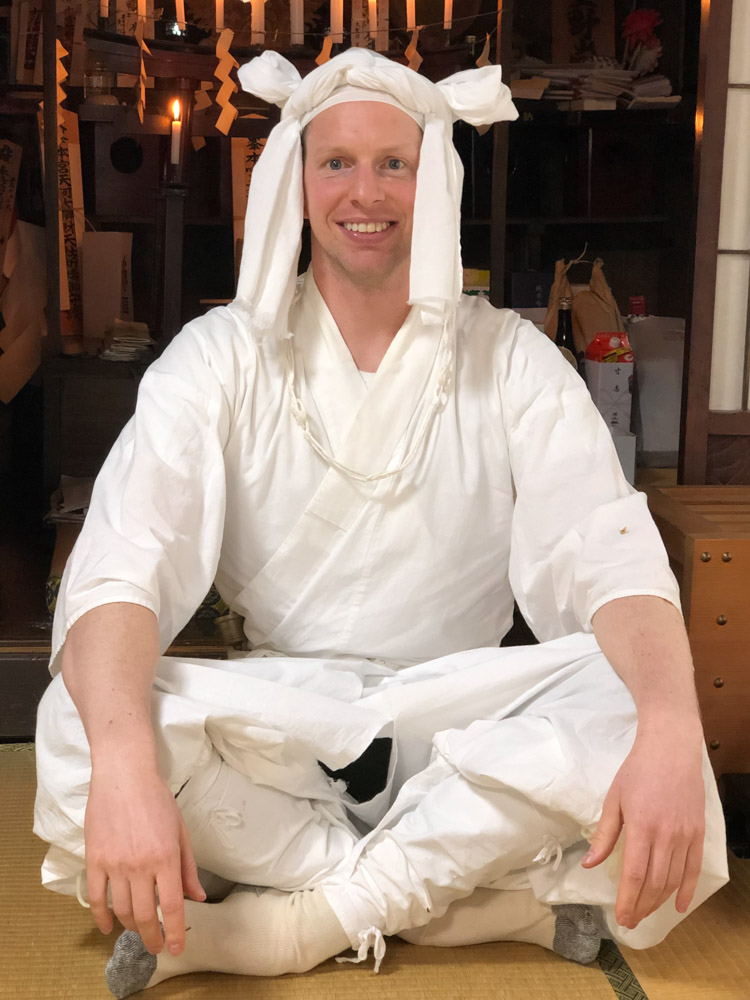
Yamabushi wear what’s called a Shime draped over our necks. The word Shime comes from Shimenawa, and the role is essentially the same: a protective barrier.
Often made with paper, the main decorated part always faces the back. We wear the Shime backwards, in other words.
This is on purpose.
You see, or maybe you don’t, evil always comes from places you least expect. Or, in other words, from places you cannot see. Since humans cannot see behind them (well, my mother with eyes in the back of her head would tell me otherwise), Shime face backwards.
So the next time you find yourself in a sacred area in Japan, wear a shime necklace, grow eyes in the back of your head, or simply pick up one of those cones lying around. Kami knows there’s enough of them.
ENJOYED THIS? HAVE MORE.
MOUNTAINS OF WISDOM
Subscribe to my yamabushi newsletter
RECENT BLOG POSTS

YAMABUSHI BLOG POSTS
RANDOM POSTS

Tim Bunting Kiwi Yamabushi
- Tim
- October 31, 2023
- 10:39 am
- 0 comments
Get In Touch
Sakata City, Yamagata, Japan