
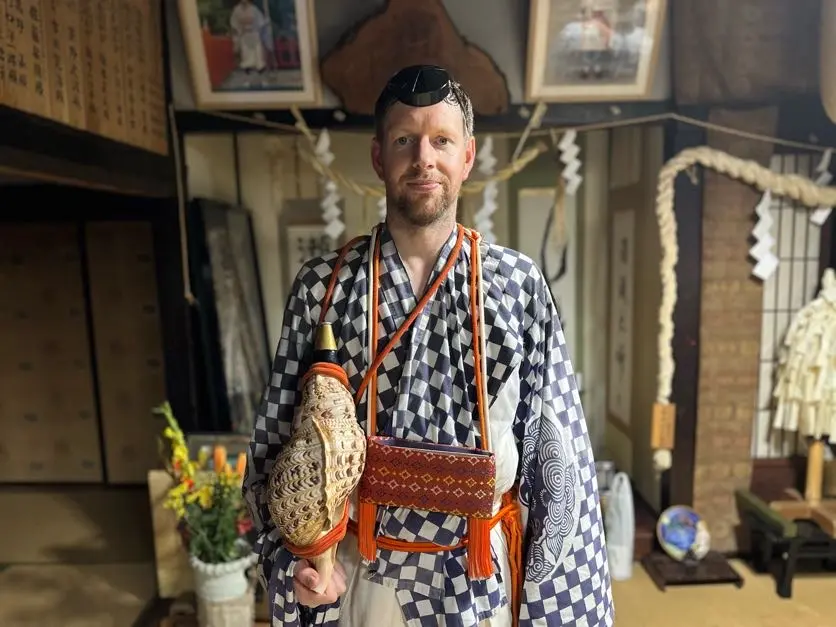
From Monday to Wednesday I taught an intensive course on Shugendo at Fukushima University.
Shugendo!
My initial thought was ‘if only Shayne’s Dahl’s book would come out a few months sooner’, because then I’d have something rather than my practice to date to base the course on.
But then again,
Shugendo!
Shugendo, what we yamabushi practice, is 100% about the experience. Theory is more of an afterthought. Unfortunately, it was a university course, and afterthought is what university courses care about the most, but I managed to balance that by taking the students out as much as I felt reasonable.
In other words, I’m pretty sure the students were happy about the structure of the course, because not only did they get credits for going outside, visiting a mountain shrine, chanting, and meditation (!), after the first day I picked up two extra students. One student in particular was so impressed on the first day they dragged along not one, but two of their cronies.
I ended up designing the course around as much practice outside as possible. This meant quite a few temple / shrine visits, and also a visit to Shinobu-yama, a mountain (in English it would be classified as a hill) right in the middle of Fukushima City.
But Shinobu-yama is not just any mountain.
It pains me to say, Shinobu-yama felt like a true representative of Japan with its unique mix of modern and traditional.
For starters, this mountain is a Shugendo peak, or at least it was in the past. Shinobu-yama has a direct connection with the Dewa Sanzan, The Three Mountains of Dewa up here in Yamagata where I train as a yamabushi.
The mountain had a few major Jinja (shrines):
- Gassan Jinja (based on Gassan)
- Haguro Jinja (based on Haguro-san)
- Yudono Jinja (based on Yudono-san)
- Hayama Jinja (based on Murayama Ha-yama)
Which is more than three.
Because the Dewa Sanzan used to be these four mountains; Yudono-san was considered the Oku-no-in, and not one of the three.
Anyway, Shinobu-yama is perhaps most famous for its Waraji festival, a festival featuring the world’s biggest Waraji, the straw sandals your flip flops (or Japan + sandals = jandals as we call them in New Zealand, true story) were based on (possibly).
So, you have these ancient shrines and temples with centuries-old festivals dotting the mountain but at the same time this wouldn’t be modern Japan without a few modern amenities (ahem),
amenities such as:
- A Shinkansen Bullet Train track running right through the centre
- Roads, for cars, that take you essentially to the summit
- A shrine dedicated to cats (Neko Inari Jinja, see photos below)
- People’s houses on the mountains
And of course,
Nuclear Waste.
I wish I was joking. One of the carparks was apparently a forest they cleared to dump the waste and the put a car park on top. I mean, they had to put it somewhere…
The one thing Shinobu-yama didn’t have, though?
A Family Mart Hybrid Supermarket.
That was further on up the road, but it did have some delicious Keema curry croquettes, among other things you won’t see in a Konbini. Like wide aisles, shopping carts, and a proper dedicated fruit and vegetables section.
Overall, the students seemed to genuinely enjoy their time learning about Shugendō, not just the practice itself, but also the extra stuff I put in like Ojizo-san, Fudomyo’o, and the reason why Japanese people can be Buddhist and Shinto at the same time.
For me, it was a real privilege to share Shugendō, something I’m deeply passionate about (as you’ve probably gathered) in a university setting.
So thank you, Fukushima!
(for being so quirky)