

This article from the Kiwi Yamabushi newsletter got more than 1,000 reads, so I decided to put it here for everyone. Get articles just like this in your inbox by signing up here. Paid subscribers get priority access and access to the full archive of over 100 articles.
What do Yamabushi do?
This is a very hard question for me to answer. Thankfully, my yamabushi master, Master Fumihiro Hoshino, already has an answer:
Put yourself into nature. Sense. Then reflect on what you sense.
-Master Hoshino
In simple terms, yamabushi are practitioners of Shugendo (修験道), the do, path or way, of gaining supernatural powers, gen, from the word genriki (験力), through ascetic practice, shu.
Anyone who practices Shugendo is referred to as a Shugenja, lit. a practitioner of Shugen. Or, more commonly these days, Yamabushi, one who promulgates in the mountains.
But what does this actually mean?
Perhaps the better question is:
What does it mean to be a Yamabushi?
When asked why to do yamabushi training, Master Hoshino gives both the most insightful, and the most frustrating answer known to man:
We do yamabushi training to do yamabushi training.
-Master Hoshino
While in the past there were full-time yamabushi, these days being a yamabushi essentially means that every so often, we head out into nature and undertake Yamabushi Shugyo, (山伏修行)yamabushi training.
I’m not allowed to divulge too much of what we actually do on the mountains for two main reasons: one is that I’ve been sworn to secrecy. The second is that entering the mountains signifies a time before we were born. As such, we aren’t supposed to have any recollection of what goes on during the training.
In saying that, there are aspects of our training you can see from the outside. A lot of our training involves rituals inside temples and shrines, and then walking out in nature visiting the locations of the kami and buddha to pray to them.
There we pray for all manner of things; a successful training, the health and safety of participants and their families, and more grander things like a good harvest, and world peace.
The praying part is what truly sets yamabushi training apart from simply climbing mountains. Master Hoshino even goes so far as to say that climbing mountains for the sake of climbing mountains is a fool’s errand. In other words, mountains are there to be worshipped, as they have been, and will be, for millennia.
Why do Yamabushi train on mountains?
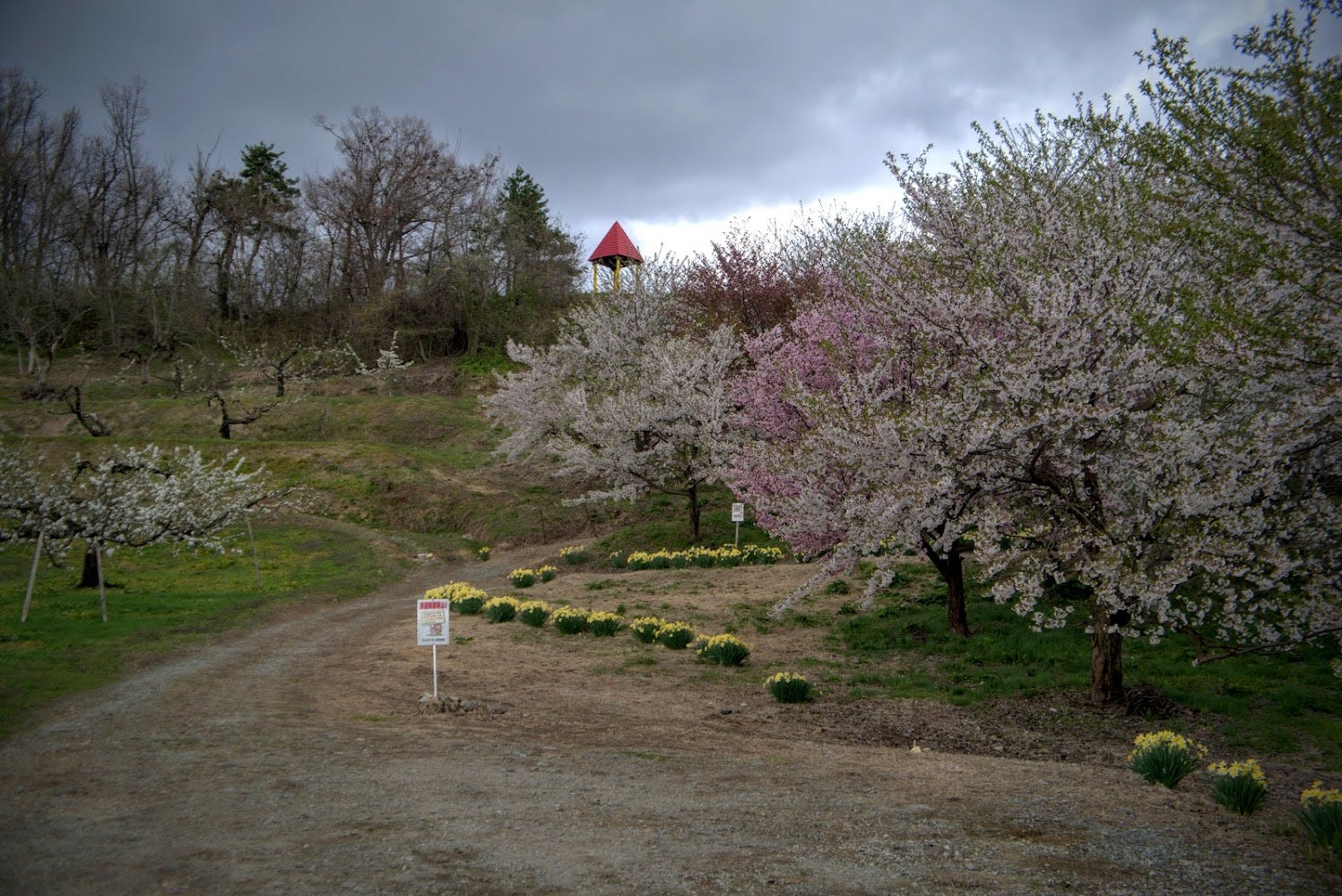
Mountains, or more generally, nature, is believed to be the receptacle of untold wisdom. Untellable, even. The kind incomprehensible to man. The only way to even begin to gain an understanding of this wisdom is to, you guessed it, get out into nature.
Called Tosogyo (抖擻行), walking out in nature is seen as its own form of meditation, and is but one way to absorb this wisdom. We also partake in all manner of rituals designed to get us closer to nature, waterfall meditation being one such example.
These lessons aren’t the sort that can be taught through spoken or written means. They must be experienced. That’s why there’s no talking, no writing, nor reading during yamabushi training. These tasks are simply seen as a waste of energy. Energy that could be spent on the mountains sensing instead.
How can one become a Yamabushi?
One can become a yamabushi by completing an official yamabushi training. Personally, I completed Dewa Sanzan Jinja (Shrine)’s Akinomine Autumn Peak’s Ritual, which was when I got my yamabushi name, Ryosen (諒宣).
On the Dewa Sanzan, you can complete the Akinomine yamabushi training through either Dewa Sanzan Jinja, like me, or through the Buddhist Shozen’in Koganedo and Kotaku-ji Temples.
Yamabushi factions used to exist all over Japan. Due to making the switch to Shinto during the Buddhist purge in the 1860s and 70s, the culture of yamabushi on the Dewa Sanzan remained comparatively intact. They still suffered a lot of damage, with up to 90% of the temple buildings on Haguro-san being destroyed. That there are still yamabushi here is nothing short of a miracle, and that they are still active is even more so.
Other areas famous for yamabushi in Japan are Kumano and Omine in Wakayama and Nara prefectures, and Hiko-san in Kyushu. I’m not sure how to become a yamabushi in these places, but it’s probably similar to what we do here in Yamagata.
Disclaimer: This information is extremely limited by my experience. I am a Dewa Sanzan Jinja yamabushi, the only school of Shinto yamabushi in Japan. Yamabushi exist all over the country, and all over the world even, and each has their own unique take on what it means to be a yamabushi.
Journeys to The Dewa Sanzan Mountains
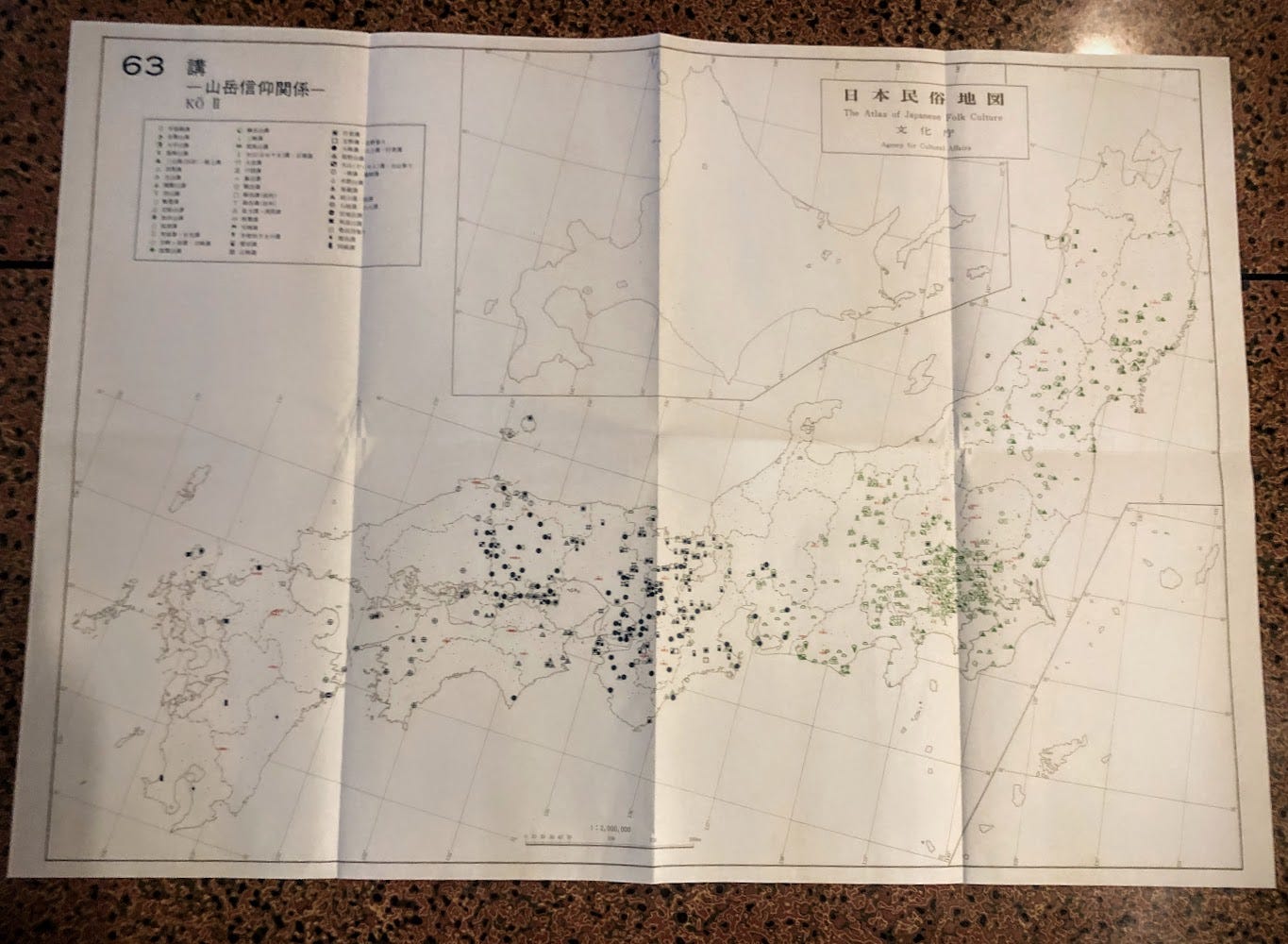
Here’s a map from the 1950s of locations in Japan where spiritual journeys originated. The green area to the right is those going to the Dewa Sanzan. The dark blue in and around Kansai and Chubu is to Fuji-san. The culture of spiritual journeys to Fuji-san (Fuji-Ko, 富士講) died out, but the journeys to the Dewa Sanzan still take place.
Yes, that does mean historically people purposely walked the 600 or so km (400 miles) from places as far-flung as Kanagawa and Chiba to the Dewa Sanzan. In many cases it took more than a month one-way.
These days people drive or take the Shinkansen. Modern people, am I right?
This article from the Kiwi Yamabushi newsletter got more than 1,000 reads, so I decided to put it here for everyone. Get articles just like this in your inbox by signing up here. Paid subscribers get priority access and access to the full archive of over 100 articles.