

Here are the most recent Daily Yamabushi posts, insights from my time on and around the mountains of Japan.
Get them in your inbox by signing up here.
-
The Time on Task Principle and making it a habit
A keen running friend of mine once noted that when preparing for a marathon, many people neglect focusing on consecutive run hours. In other words, many people put their focus on achieving distances rather than running for time. They assume the aggregate of their running hours will suffice.
In certain cases, like people who have done it before, it might just.
But when you’re trying to build a habit, time on task is about as important a principle as it gets.
Rather than focusing on doing the task well, first focus on doing the bare minimum. Focus on the sensation of doing it, on getting a feel for it, on getting the knack for it, rather than results.
Then, focus on linking these sensations together.
Soon you will start to feel more slack, and you will be able to go further for longer. It is the combination of these sensations that leads to the results you wanted in the first place.
-
How I got featured on the Japanese Prime Minister’s YouTube
It’s not every day you get featured on The Prime Minister of Japan’s YouTube channel.
Today I did.
Here’s proof:
I’m not doing this to show off (OK, maybe a little, but I also understand it’s just one video, not exactly world-changing stuff). Either way, I want to explain how this happened as I think there are important lessons in it.
A few years back I helped start a website, dewasanzan.com (by help I mean I basically made the whole thing). This website features what I think is the best place in Japan to experience the country’s spiritual side, and the perfect place to come and refresh and get ready for tomorrow.
Well, as part of that, I wrote an article as to why you simply must try Dewa Sanzan Shojin Ryori, the ascetic meals of the region. I spent a long time writing this article, as I had to research not only Shojin Ryori in general, but how it pertains to the Dewa Sanzan.
As with many things here in the Shonai region (a region the size of Tokyo with three Japan heritage sites, the only such place in Japan), this was no easy feat as the area has been highly specialised for centuries now (it was even the basis of The Last Samurai).
Then in October out of the blue an inquiry comes in asking for assistance in creating a video. I inquired deeper, and obviously this was the video.
At first I was asked my credentials, and I shared the Dewa Sanzan Shojin Ryori article along with a bit of my other work. At the time I also asked what I could do to ensure I was accepted, and was essentially told to do what I did (another good lesson)!
And from there, I was selected, and the production process started. A few of the shots are things I told them to get, that wouldn’t have been possible without local knowledge, another advantage of picking me, and another advantage of starting a YouTube channel. I now look out for these shots much more than I used to!
When I started dewasanzan.com, I had no idea where it would take us. And therein lies the biggest lesson.
If you get the urge to share your ideas in any way shape or form, try and get them out as soon as you possibly can. Don’t let them fester in your brain, let them fester on the page, or in the video, or on the mic, whatever the medium may be! Just don’t let them fester in your head!
Ideas work precisely because they are spread. And they spread because you spread them! Not simply because you have the idea.
-
No More Excuses
Some excuses are perfectly justified.
For everything else, ask yourself how you are getting in your own way. How are you trying to sabotage your own efforts? And what can you do to stop it?
This is a classic example of what Stephen Pressfield describes as the resistance (seriously, read this if you haven’t before).
Some excuses are unnecessary extensions of justified ones. Some are downright unjustified.
Your task is to know which is which, and to have the nous to know when you’re only fooling yourself.
Once you know, you can get back to doing what it is you have set out to do.
We humans are idea machines. However, at the same time, we’re also very good at not letting these ideas see the light of day. And often all it takes is a kick up the bum, or a tiny mental shift.
Get out there and let your ideas spread!
-
Two keys to living well
Appreciation and acceptance.
That’s it.
Appreciation for the now, appreciation for life, appreciation for being.
Acceptance for the now, acceptance for life, acceptance for being.
When we appreciate, we look for the good in everything. We think positive about our place in the world, and how much our world has given us.
When we accept, we understand there is a natural way of the world, and that we are a part of it no matter what.
Appreciation and acceptance. That’s all it takes.
-
The ability to say no is a core leadership trait
Being able to prioritise is a core competency for leaders. If you aren’t able to say no to more than a few things, you risk losing course on your main mission, the one you are supposed to be leading.
It’s easy to get caught in the trap of meetings, committees, and the like. However, if all these things do is bring you away from your main mission, you either need a new main mission, or to say no to those things.
There’s no two ways about it.
What is your mission? What are the things that could potentially derail it? Why are you doing those things?
(Rant over).
-
Use this powerful Yamabushi phrase to help get through
During the night I had the strong urge to check my phone. You know the one. Lying there alone with your thoughts and anxieties as everyone else lies asleep, wanting the answers the phone is never going to give you. It’s exactly why I don’t sleep with my phone in the same room, to remove the temptation from the equation.
But the temptation was so strong.
In yamabushi Shugyo (training), we are constantly told to do things. This means we constantly say Uketamo. We are constantly saying to ourselves ’I accept’. To be able to move on, we must accept our current selves. We must accept ourselves for who we are.
So I tried that.
Every time I felt the urge to go and get my phone, I said to myself, ‘Uketamo, I accept myself for who I am’*.
Eventually I got the message and fell asleep.
The next time you find the urge to do something you ought not to, try the phrase ‘Uketamo, I accept myself for who I am’.
And if you do that enough times, you might just fall asleep. Or at least, be able to carry on your day without temptation.
* This is but one interpretation of Uketamo.
-
Where to start, where to finish
When I first started writing up my experiences climbing the 100 Famous Mountains of Yamagata Prefecture, I didn’t expect them to turn into the major tomes I have since created. My Gassan article is nearly a 30 minute read, and my Haguro-san draft is 1.5 times that. Plus I’ve just written a 15-minute read on Chokai-san, even after breaking it up into three articles.
In fact, if you look at my first articles (Kinbo-zan, Arakura-yama, or Takadate-yama), you’ll see how much more in-depth I’ve become.
So, the simple question is:
Who’s going to read all that?
The fact is, there’s soooo much background information on these places that I want to include, it’s hard to know where to start, and where to finish.
(For example, did you know that Chokai-san wasn’t even considered a mountain in the past? Or that its name was given to it by En-no-Gyoja? I didn’t, and I’ve lived in Chokai-san’s shadow for more than 12 years)
Which is to say, you really do have to think about the reader if you want these things to be read, and you have to be realistic about it too.
With our forever-shortening attention spans, these days things need to be broken up into bite-sized pieces to have any chance of getting consumed.
So, from now on, I’m going to start the process of splitting up my articles. And if you’re anything like me, I’d recommend it too.
Or, you know, maybe write a book instead?
Don’t worry, you’ll still be able to read it all, it’s just that you may have to look a little bit harder. Or perhaps, depending on how things are organised, you will have a better time overall as similar articles will appear together.
My first port of call will be deciding how I want to categorise things, starting with simply things related to the mountains I’ve climbed (yesterday’s post on The Astounding Waterfalls of Chokai-san was a teaser).
-
What losing a parent in your 20s teaches you
First up, all you need to know is that my favourite movie was right.
Now onto the article:
Dad died all of a sudden. Even the family doctor shared his shock at his funeral.
Luckily Dad was doing what he loved, being outdoors, hiking. Can you guess where my love for the outdoors comes from?
Experiencing the death of a parental figure at any age is sure to have an impact. And I’m sure it’s fair to say the younger you are, the greater the impact.
I was still sorting my life out.
And then this happens.
Spanner.
Works.
Or perhaps you could say, it was the kick up the bum I needed.
For years until then I had been thinking of many things I wanted to do. However, I hadn’t pulled the trigger on any of it. I guess I was waiting for someone to come along and give me permission or something.
Well, that person was gone. Or at least I discovered for certain that they never actually existed in the first place.
Now with the constant reminder that we aren’t long for this earth, I tend to do things for the sake of doing them a lot more often than I did before. I err on the side of action.
In a weird way, losing a parent is extremely freeing. Sure, you lose someone who, for me at least, was a major guiding figure. However, guiding figures come with their own form of pressure that you have to live with.
Now I get to imagine what he’d say instead. And I get to manipulate his words to my own liking.
What I would give to have dad’s real advice now though.
In spite of that, I’m hoping others can benefit from the lessons I have learned along the way.
Hence the blog.
Japanese Attitudes to Death Really Helped
Japanese attitudes to death are much more healthier than in the west, or at least for European New Zealanders. We have a funeral and then sort of do things for that person, i.e. visit their grave, whenever we feel like it.
It’s telling that there is no native word for death in Japanese. 死, Shi, is a loan word from Chinese.
For the ancient Japanese it was believed that when you passed you didn’t go to another realm, your soul actually went to the nearby mountains.
I guess Dad got a head start.
Either way, this means by going to the mountains, you can actually go and visit your ancestors. This is why Gassan is known as the world of the afterlife. I have a friend who makes the pilgrimage to Gassan annually for this exact purpose.
And then every year at Obon, the ancestral spirits are welcomed into family homes. It’s another chance to be in the presence of those who have gone before us.
How beautiful is that?
There is a built-in culture the Japanese have for periodically commemorating the lives of those lost. They make a real point of the fact that without the ancestors, we too wouldn’t be here.
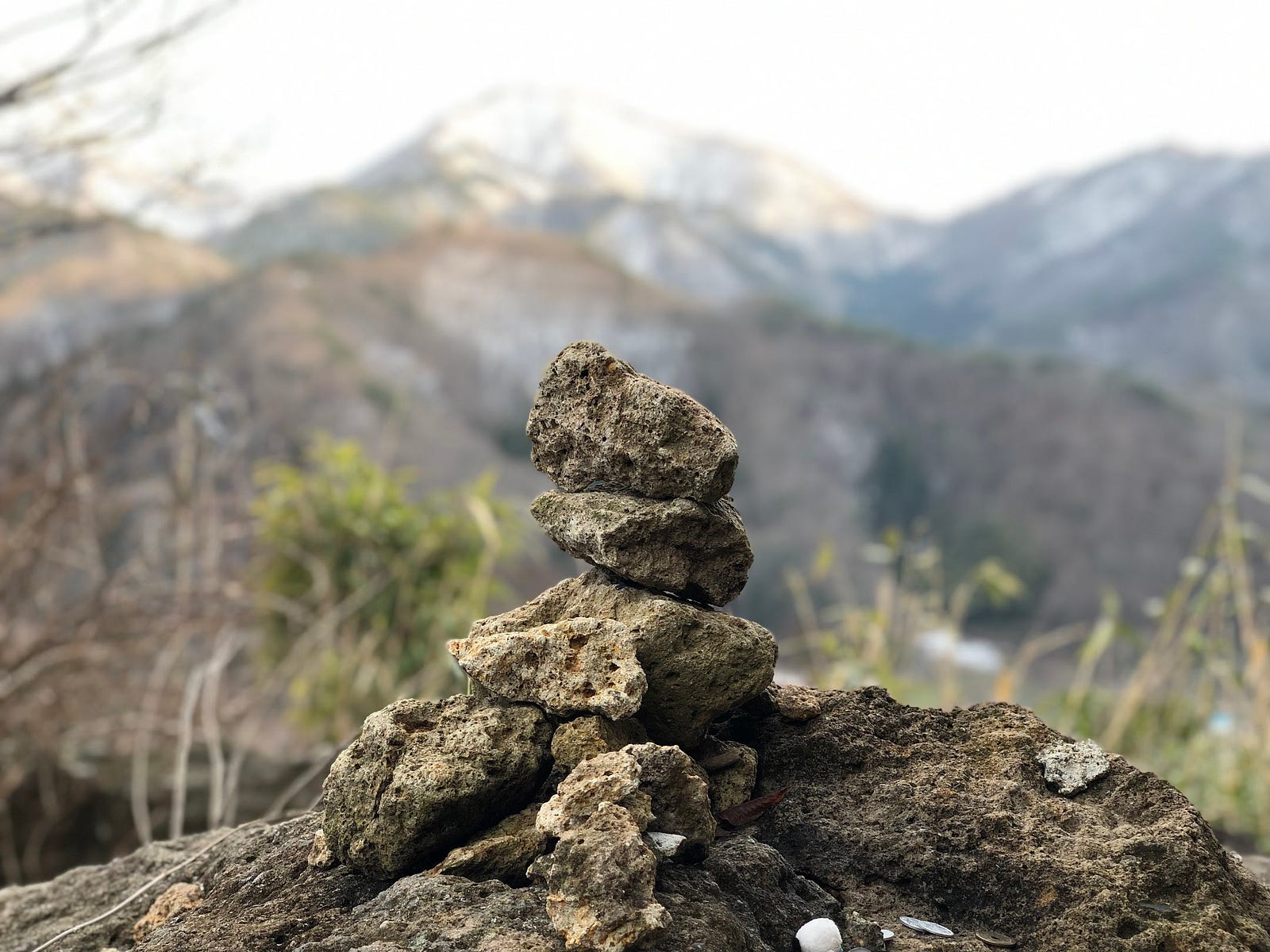
Now every year at Obon I take the chance to think about Dad and the others we’ve lost along the way. And the same goes for every time I visit Gassan, or the Reisaiden (Hall of Ancestral Spirits) on Haguro-san for example. Or anytime I pass a Jizo statue or the piles of rocks you see on the mountains here.
The irony being, of course, that death is kegare in Shinto. It’s to be avoided at all costs. Thank Kami the Buddhists won this one I guess.
Which is to say
Having experienced the death of a parental figure in my 20s, there are a certain number of silver linings. Ones that I hope you can learn from too.
The conclusion is a simple one, my favourite movie was right; Get busy living, or get busy dying.
-
Examples of what not to do
An example of what not to do still comes from having done something. This means you or someone else has taken action that gives insights that otherwise wouldn’t have existed.
Don’t think of examples of what not to do as that person being stupid. Think of them as a chance to see how things can and should be done differently.
And remember, it’s better to regret something you did, than something you didn’t do.
-
How Yamabushi get through the tough parts
A few weeks back I was climbing Chokai-zan, the tallest mountain entirely in Tohoku and one of the 100 Famous Mountains of Japan. Or, I should say, I was filming on Chokai-zan. I was so taken aback by the scenery that I spent a large portion of the climb filming. And if you know the style of filming with a lot of walking back and forth from the camera, this takes a lot of time.
So, with a tall mountain, and a whole lot of filming, I really should have been more conscious of time. But I wasn’t, and in the end I had to start rushing to get back to my car before the sun fully set.
Not only had the climb been steeper than I imagined, it was also on top of large boulders for a majority of the way, and my feet had started to give out. I developed blisters on the soles of my feet that are still healing. That coupled with the sneakily sinking sun, and the fact that my phone was running out of battery, was cause for alarm and I had to scurry down the mountain.
During yamabushi training when things get tough like this, we sing. There’s a song that goes ‘Rokkon Shojo (Rokkon Shojo), Zange, Zange, (Zange, Zange)’, which is basically ‘purify us for our six Āyatana (sense bases), repent, repent’. (Legend has it that this is where the saying ‘dokkoisho’ comes from in Japanese). This and a combination of reciting The Heart Sutra helped me get back in time.
I got back to my car while the sun was very low in the sky, and my phone battery at 1%. But I still made it! And singing this song certainly helped!
-
Too much on your plate? Use this tip to get things done
Do It Tomorrow and Other Secrets of Time Management by Mark Forster is basically all you need. However, there is one technique in there I have implemented in my own way to great effect.
Do It Tomorrow talks about having a current initiative; something besides your day to day that you are working on (or it could be your day to day), something that is your current big project. My problem is that I have too many of these. And it took me seeing them all in visual form that I was able to admit this.
My tip is this: Use the notion kanban feature, or use Trello or some other means of getting your projects in a simple to see and manipulate view. This alone was enough for me to see that I had too much on my plate, and that if I were to get through any of it, I would need to prioritise things.
So, I put what I really want to work on next in my ‘current initiative’ column. Right next to that, I have a ‘back burner’ column, where I put things I want to work on next.
Not only does this help you prioritise your projects, it also lets you more easily compare them. The project you should be doing first is the one you see to have the most good repercussions down the line, and this gives you a much easier way of seeing exactly what that could be. It also helps you see what you should be working on when you’re feeling a bit lost.
So, give it a go, and let me know how it worked!
-
One easy way to improve your second language reading speed
Reading speed is often one huge factor that determines whether we pass an exam or not. Not only that, when we can read fast and accurate, we can absorb information fast, and that means we can make decisions fast as well.
Here’s a well-known technique in applied linguistics’ circles, but one that still doesn’t seem to be implemented in classes that much. The trick is very simple:
Read a whole lot of stuff that uses almost exclusively words you already know.
That’s it.
This means language that you know is either at your level, or below it. The easiest way to do this is to read stuff that you’ve already read before. But if you can, do it with a timer or some way of pushing yourself to read faster.
It works, I’ve done it myself, and seen students improve this way too. Try it.
-
Trust in the process
Trust in the process. Trust that the process is the right one. If the process isn’t the right one, make it the right one. Either way, trust in the process.
-
Hit the Ground Running: Start your New Year’s Resolutions Now
Now’s a good time to prepare for your New Year’s Resolutions. We shouldn’t need an arbitrary day or time of the year to remind us to get around to what we have been meaning to do, we can do these things whenever we feel like it, but New Year’s Resolutions are often a very good excuse that provides the kick up the bum we need!
And I’m here to remind you of that.
If you get started now, it means you can hit the ground running. It means you can prepare in advance for what until now has obviously been a little out of reach for whatever reason. In theory, it should give you a better chance at success too, because, besides delaying things getting tough, you’d have already thought ahead of what to do when things get tough, right?
You can start on the project now if you like, but you still have some time to prepare for it, and this is your reminder to do so. Or at least, think of this as a chance to think of what it is exactly you have been meaning to do, and how you can do it.
-
Life is all the permission you need
If you feel like doing something on a whim, do it. If you feel like you need to do something for yourself, go ahead and do it.
We never know when the proverbial is going to hit the fan. But we do know when it has, and we do know that sometimes we just need to let our energy out.
Of course this should be done in a way that doesn’t harm others, but the urge to do something is all the permission you need. The fact that you’re alive is all the permission you need.
-
The ultimate Dojo
If you know how to deal well with things thrown at you during ascetic training, you have the techniques to deal well with basically anything life throws at you.
Ascetic training puts you in situations where you are tested and challenged. It requires you to use your natural instincts to get through, to rely on no-one but yourself.
More importantly, however, it proves to you that you can do it. It gives you the belief and conviction in your own self and your own abilities needed to get through.
But the thing is, while ascetic training can certainly help with this, there are plenty of other experiences that teach us the exact same thing. We just have to be wise enough and attuned enough to realise what those things are, or in most cases, have been.
-
Some feelings you can’t outlogic
As much as we’d like for it to be so, some feelings you can’t outlogic. Some feelings are just too strong, or they hit you at exactly the wrong time and it overwhelms you.
This doesn’t mean we can’t label the feelings. And it doesn’t mean we can’t recognise them for what they are.
Often these feelings are simply an overreaction to a quickly developing situation, and often this is due to that situation alone.
Other times, our reactions only go to compound the feelings, feelings that could have been nipped in the bud, but we were too emotional in the moment to see that.
Take a few breaths. Look at the situation from afar. Think about how you would feel about the situation 5 days from now. More often than not, we wouldn’t care an inch about it. Label it for what it is, an overreaction in a tense moment, and then get back to doing what you were doing.
We may not be able to outlogic some feelings in the moment, but at least we can soon enough.
-
Creativity is your girlfriend
Give her attention and she’ll flourish. Your relationship will bloom, and you’ll always have someone to turn to.
Disrespect her, and you’ll be on the receiving end of her wrath. Or worse still, you’ll lose her.
Creativity is like tending to a garden, constant upkeep and consideration is a must for there to be anything fruitful.
-
Why I write every day: And why you should too
Since January 1st, 2019, I have pushed publish on a blog post every single day. That’s nearly a 1500-day streak by now.
But why?
The simplest reason is that my favourite author does it. Seth Godin is famous for having written a blog post every single day for around 20 years now. His streak is numbering in the 7000s and with around 20 bestsellers to boot, it’s hard to deny that there’s some sort of magic in it.
The Daily Discipline
No matter what it is, simply having a daily discipline is a great way to keep yourself accountable. It’s a great way to all but force yourself to show up, regardless of what’s going on in your life, or even your feelings about what’s going on (this is much bigger than you would think).
In a way, daily disciplines mute you to what’s going on.
Positively, mind you.
A daily discipline is a way of helping you focus on simply being you in spite all the things that are going on. This keeps you grounded, and helps in building a positive mindset.
Since it’s daily, it’s ongoing too.
Contribution Over Consumption
By writing daily, instead of simply consuming content, you’re contributing content.
Those who have done it know the difference is stark.
And it’s addictive.
It’s so addictive you find yourself wanting to create at odd hours of the day.
Not only that, since it’s daily, you find yourself searching throughout the day for the next big idea.
On a subconscious level.
What’s something I could share? What’s something that could really move the needle on this thing?
Before you know it, your thoughts are being channelled positively towards your next contribution. Your ideas have gone from rolling around in your head to having a much greater chance of doing good.
And by no means is this limited to your blog.
Generation and Communication
Speaking of ideas, we have an endless flow of thoughts, we never run out of things to say. Unfortunately, these thoughts or ideas aren’t always that great. However, writing them daily is one way to get the bad ideas out of the way so that we can focus on the good ones when they come.
Plus, when these good ideas do eventually strike, we’ve already built up a writing muscle. This means we’re able to express them more succinctly and concisely than we would have been able to had we not written every day for the past few years.
People respect people who can communicate eloquently. People respect people who are concise and straight to the point.
No showboating.
No ego.
Just good ideas articulated well.
How to Write Daily
The first and only rule is, hit publish every day.
That’s it.
You can do it for free using medium.com and use a pseudonym if you like.
No one says you have to use your real name. No one says you have to build your own website. No one says you have to invest in expensive software.
The best thing is, you can do it from anywhere. I’m using my phone right now, and you can too.
Your daily efforts channelled positively. Your ideas out there for the world to see.
And all it takes is the push of a button.
-
Voice and Views
The filming of my latest video has been a bit of a disaster. Or, you could say, a very good lesson.
To make videos engaging, there must be a variety in voice, and in views. For example, mixing views of talking to the camera with voiceovers.
However, I focused too much on getting footage of talking to the camera. This came at the expense of quality voiceovers.
When you’re looking at the camera while filming, you have to remember a lot more as you can’t just read your script. At the same time, you can’t just read your script when doing voiceovers, because it tells. However, you can take a glimpse at your script along the way. This makes it much easier to add in the all important emphasis as well as timing.
In other words, both are important at creating a compelling story. But if you try to film both consecutively, it takes a lot of effort and time.
The lesson here is to decide in advance which parts of the script will be on camera, and which won’t, then record accordingly. Not only does this lead to a quicker turnaround, it also leads to a better quality video, which is something to always strive for.
-
Accept and Release
The in breath is acceptance, the out breath release.
When you have a frequent practice such as yoga or anything that helps you focus on your breath, it makes it much easier to be cognisant of whether you’re tense or not. When you’re used to actively relaxing your body, you start to notice when your body is tense, and you can also tap into the powers of yoga and the like that allows you to release the tension.
Check yourself right now, are you tense? If so, can you allow yourself to relax?
No judgment. No blame. Just accept the tension, then release it.
The in breath is acceptance, the out breath release.
-
The Nature in Our Nature
Nature is in our nature. It’s natural for us to want to be in nature. Nature is where we are nurtured.
But sometimes we forget that.
Sometimes we get stuck in our heads, which is quite possibly the furthest thing from nature.
But by getting out in nature, and staying there, we can learn what it means to Uketamo again, and we can restore our heads to our true nature. We can make being in our heads, being in nature.
But the only way to do that, is to be in nature.
It’s in our nature.
-
The gravity of the situation
Never let the gravity of the situation get to you. The situation is what it is, things might not be as normal as they usually are, but the gravity of the situation has no standing on how you should feel. If you’re able to accept the situation for what it is, it means you can also in a sense forget about the gravity of the situation, and focus on what you are there to do.
Often the added pressure that comes along with the gravity of the situation is just excess baggage. It’s unnecessary to think about and only makes you do a worse job. Focus on being in the moment. Focus on what the moment can bring, and on what you can bring to the moment. Not the situation.
-
How goggles taught me acceptance (Uketamo)
I think I cursed myself with yesterday’s post. I went to the pool trying to ignore all the signs (which is impossible, I swear there’s more now). And when I was swimming, something that had never happened before happened.
My goggle strap split.
I had to abandon the swim then and there. I probably could have gone and asked for some spare goggles, however that would involve getting changed, and also, Japanese goggles don’t go well with my Caucasian nose (I recently bought some only to find they didn’t fit).
So, I accepted the situation for what it was, swam 100m head-up (waterpolo style) to finish my set, and got out.
I was shocked and disappointed. But I know that when you’re in a situation like that, it’s very easy to make things worse for yourself if you can’t control your emotions. When there’s truly nothing you can do, it’s best to Uketamo, to accept the situation without fuss, and move on.
But now I need a new pair of goggles…
-
Laminator Land: What to do with all the signage in Japan
My local swimming pool is a real attack on the visual senses, but no one seems to notice it but me.
Before you even step foot inside the building, you are bombarded by signs.
Of course there’s the usual ‘no smoking’, and ‘no open flames’ (for some reason, there are a few of these). But there’s also notes about how every day at 12 they close the pool for ‘safety’ (which is ridiculous in and of itself, what are lifeguards for?), detailed notes for when parents can pick up their children, notes on who can enter where, and more.
Need I remind you this is before you go inside.
Once you’re inside, it’s even worse. There are signs that have obviously been there from the start, like a map with the fire exits, and a sign about pool rules. These signs are fine.
The ticketing machine and the office window where you get your ticket scanned are both, you guessed it, also surrounded by signs.
Keep walking down the corridor, and it doesn’t get much better. There are even signs right in the centre of the mirrors in the changing rooms, right where you’d want to use the mirror for mirroring.
Do they expect us to read them all? As if that’s the only way they can share the rules. Looks like someone got a bit laminator happy.
But there’s a simple solution to this, one that is extremely obvious by visiting any worthy sushi shop or other place that has at least a smidgeon of pride in aesthetics.
Besides throwing the laminator away, as much as possible, get rid of any written characters. Use pictures if you need to. And keep the pictures isolated too, show off the wall. I’d much rather have a plain wall, than a wall of plain text.
And it wouldn’t be that hard to do!
(This is to say nothing of Haguro-san, which is also a bad culprit! I’ve been trying to get this changed, but the signs are seriously like the Hydra!)
-
Active and Passive Vocabulary Learning in a Second Language
I have a theory when it comes to learning vocabulary in a second language that goes like this:
We know that both active and passive learning of vocabulary is necessary. My theory is that each should be as much like the other as possible.
For example, if you’re doing the active vocabulary task of looking through lists, a word list, or a dictionary to learn words, then you should always have an example sentence to review the word in a more passive situation. This helps to provide the vital context needed to truly understand the vocabulary. Just looking at the isolated vocabulary alone is not enough, in other words.
Similarly, if you are reading or listening to something, the text must contain the target words. This second point is made all the more easier through the huge range of graded readers, and now graded listeners available. Being able to separate texts into number of headwords is a huge advantage, in other words.
If you can, when learning vocabulary in a second language, you should try and mix up your learning in these ways. It may be more of a hassle to set up this system, but it will definitely pay off in the long run.
My definition of active and passive vocabulary learning
Active vocabulary learning is when you specifically choose the words you wish to remember, such as choosing them from a glossary, a word list, or even a dictionary. Passive learning is getting exposure to the language be it written, spoken, or otherwise (listening is also seen as an active skill, as when you listen, you respond by letting the speaker know you are listening).
-
Practice and Process
I just re-did some voiceovers I had done, nothing too bad though. This is all part of the process of trying to better my communication skills.
The reason for the re-recording; my voice is a bit lacklustre! Even with a professional mic. I find that the further along in a recording I get, the less energetic my voice sounds, so by the time I’m halfway through a video, that alone is a good enough reason to stop for a break.
Tone of voice portrays a lot more information than you’d expect. I try to smile as much as possible during recording, but even then sometimes it’s not enough. Sometimes I have to focus on hitting the higher pitches, otherwise my voice becomes a bit droning and hard to listen to.
Either way, this is yet another thing to focus on when recording video. I think the original take wasn’t good enough because it was obvious I was reading a script, or at least trying too hard to memorise it. But I got over that by actually memorising it, and then focusing on making the recording sound as natural as possible.
The thing is, my voice isn’t naturally that energetic anyway, so I hope I don’t come across as too unnatural when the video is released, which it will be soon! At least I won’t sound lacklustre though. It’s all a matter of practice and process!
-
Flexing your Uketamo Muscle
To practice Uketamo is to practice acceptance. Yamabushi training is a way of practicing Uketamo, as is simply being in nature, meditation, creative endeavours, or anything else aimed entirely at putting you in the moment.
Acceptance is always the fastest way to move on. If you don’t accept things, there will always be something nagging you in your head until you do. Therefore, frequent practice of Uketamo is ideal.
We never know when we will have no choice but to accept things. Frequent practice means your Uketamo muscle is better prepared to get through the inevitable when it comes.
That is why frequently doing things like yamabushi training, being in nature, meditation, creative endeavours, or things aimed entirely at putting you in the moment are so important.
-
Hearing the echo
Playing a Yamabushi conch is not easy. It takes time to train your lip muscles and lungs (and stomach!) to get the right tones at the right times, and even after years of practice you don’t always get the intended sound.
However, there is one thing you can quite easily control; your timing.
The really cool part about the conch is not the sound that comes out, but rather the sound that is echoed back to you. So much so, it’s almost as if you play it to get that echo.
Yet if your timing is a bit too quick, if you are hurried, in other words, you completely miss that echo.
Keep the echo in mind. The timing will follow.
-
Your part in the journey
Everyone is equal precisely because we are at different points along our journey. Those who are ahead, look to them for advice. Those who are behind, look to lift them up.
Never be dejected for not being far along in your journey. Focus your actions on getting to where we want to be. You will get there in due time.
Never treat people as lesser. We too were where they are now sometime in the past. We too were able to benefit from the advice of those ahead of us.
Know your position, but know it is mobile. Know we are all moving one way or another.
Give yourself and others the space they need to move along their path. Everything is a process.
What is DAILY YAMABUSHI?
Daily insights from my time on and around the mountains of Japan. Get them sent to your inbox daily by signing up below.
Sign up for the weekly Kiwi Yamabushi Newsletter here.
Read all Daily Yamabushi posts here.